
Dot Paper Printable
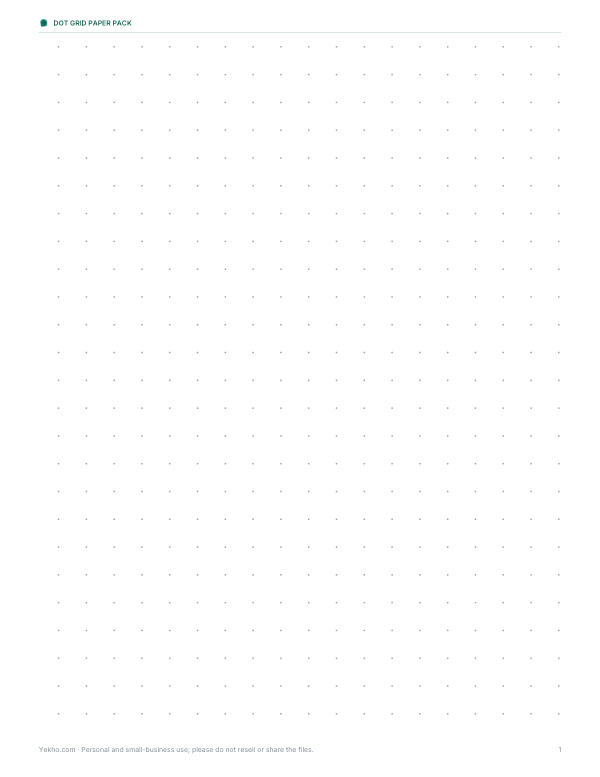
Dot grid paper gives you structure without the heaviness of lines — perfect for bullet journals, sketching, lettering, diagrams and maths. Choose the spacing, dot size, colour and paper size, preview the page, and print it or download it as a vector file.
- Free to use
- No sign-up
- Runs in your browser


Dot paper maker
Dot Grid Paper Pack
Printable dot grid paper in 4 mm, 5 mm, ¼ in and 1 cm spacing, isometric dot paper, large-dot kids paper and bullet journal starter pages.
- 5 mm dot grid (PDF)
- ¼ in dot grid (PDF)
- 1 cm dot grid (PDF)
- Isometric dots (PDF)
- Bullet journal pages (PDF)
Formats: PDF. Instant download after payment (link valid 72 hours, up to 5 downloads). AI-assisted: the templates were drafted with AI help and reviewed and laid out before publishing.
$3.00 USD, one-time 5 files · about $0.60 each
- Instant download
- 7-day refund
- Secure checkout by Stripe
7-day money-back guarantee. Full refund within 7 days of purchase, even after you download.
Free sample: Bullet Journal Starter (PDF, 195 KB)
Full refund within 7 days — see the refund policy and license.
Free printables
Single sheets you can print right now, no sign-up. The full pack adds every sheet in one download plus the editable files.
 Printable Isometric Dots
 Printable Bullet Journal Pages
Choosing a dot spacing
| Spacing | Good for | Notes |
|---|---|---|
| 4 mm | Small handwriting, dense notes | Many dots per page |
| 5 mm | Bullet journals, planners, sketch layouts | The most popular dot grid spacing |
| ¼ in (6.35 mm) | US-style notebooks, general notes | Close to college-ruled line spacing |
| 1 cm | Maths, graphs, children | Easy to count |
| ½ in or 1 in (large dots) | Young children, geoboard-style shape games | Use the large-dot layout |
Print at 100% (actual size) to keep spacing exact — “fit to page” shrinks it slightly.
Square vs isometric dots
Square dot grids line up in rows and columns, like graph paper with only the intersections printed. Isometric (triangular) dot paper offsets every other row by half a space, so the dots form equilateral triangles — ideal for drawing cubes, 3D shapes and isometric designs without a special ruler. Large dots with generous spacing suit young children joining dots, drawing shapes or playing the classic “dots and boxes” game.
Worked example
A bullet-journal user prints a week of daily pages on A5: 5 mm spacing, 0.5 mm grey dots, a 10 mm margin and a header line for the date. The preview shows the number of dots and the grid size, confirming that the grid is centred with even margins. For a maths lesson, a teacher switches to isometric dots at 1 cm on US Letter and prints a class set for drawing 3D shapes.
Ideas for dot grid pages
- Bullet journal spreads: monthly logs, habit trackers, weekly layouts.
- Hand lettering and calligraphy practice with consistent letter heights.
- Sketching floor plans, garden layouts and wireframes.
- Maths: graphs, symmetry, area and perimeter.
- Games: dots and boxes, pixel art and pattern design.
- Knitting, cross-stitch and quilting charts.
Dot grid vs lined vs graph paper
| Paper | Strengths | Drawbacks |
|---|---|---|
| Dot grid | Guides writing, drawing and layout without dominating the page; works in any orientation | Less guidance for very neat handwriting |
| Lined (ruled) | Fast, tidy writing | Lines get in the way of drawing and tables |
| Graph (squared) | Precise charts and plans | Busy background for writing and sketching |
| Blank | Total freedom for art | No help with straight lines or spacing |
Dot grid sits in the middle: you can write along the rows, draw boxes and tables along the dots, and sketch freely between them — which is why it’s so popular for planners and notebooks.
How to set up a bullet journal on dot paper
- Number the pages and leave the first two for an index.
- Add a future log: split two pages into six months each using the dots as guides.
- Create a monthly log with the dates down the left and a task list on the right.
- Use daily or weekly logs with short bullets: • task, ○ event, – note.
- Migrate unfinished tasks at the end of each month.
- Add collections — reading lists, trackers, goals — wherever you like and list them in the index.
With 5 mm spacing, each dot row is a comfortable handwriting line, and two rows make a good heading height.
Dot size and colour
Smaller, lighter dots are easier to ignore when you write or draw over them, while larger, darker dots are easier to see for young children and for people with low vision. A dot of about 0.4–0.6 mm in light grey is typical for journals; 1–2 mm dots suit maths and kids’ activities. If your printer makes dots look too faint, step up to dark grey rather than making them much larger. Coloured dots can mark different notebooks or subjects.
Accessibility and visual comfort
Some people find dense grids visually busy. Try wider spacing, lighter dots or a header area to reduce clutter. For children learning to write, larger spacing with bigger dots gives them room to form letters, and you can use every second row as a writing line with the row between as a gap.
Games and activities on dot paper
Dots and boxes is the classic: two players take turns joining neighbouring dots, and whoever completes a box writes their initial in it and moves again. Large-dot pages also work for copying shapes, drawing symmetrical patterns, making pixel-style pictures and exploring area — count the squares inside a shape, then check by multiplying length by width. On isometric dots, children can draw cubes and build up the views of small block models.
Printing tips
- Choose light grey or blue dots so they fade into the background of your writing.
- Use 90–100 gsm paper for fountain pens and markers.
- Print double-sided for journals; check that the grid lines up front and back.
- Punch holes before binding and leave a larger margin on the binding side.
- Download the SVG for crisp printing at any scale.
Privacy
Pages are generated in your browser.
Frequently asked questions
What is dot grid paper?
Paper printed with evenly spaced dots instead of lines or squares.
What spacing is best for bullet journals?
5 mm is the most popular.
What is isometric dot paper for?
Drawing 3D shapes, cubes and isometric designs.
How do I keep the spacing accurate?
Print at 100% (actual size), not “fit to page”.
Can I make A5 pages?
Yes — choose A5 as the paper size.
What dot size should I choose?
About 0.4–0.6 mm for journals; 1–2 mm for kids and maths activities.
How do I set up a bullet journal?
Start with an index, future log and monthly log, then add daily logs and collections.
Is dot grid better than lined paper?
It’s more flexible — good for writing, drawing and tables — while lined paper is better for fast, tidy writing.
Can I print double-sided?
Yes; check that your printer lines up the margins on both sides.
Can I download the page?
Yes, as an SVG file.